
Ava Stein
IU Indianapolis: Elementary Mathematics Educator
Addition
Meaning
Addition means to combine elements together to produce a sum.
Whole Numbers

The partial sums algorithm is particularly suitable for addition because it breaks down the addition process into individual place values. Instead of adding the numbers traditionally, students can go place value by place value. This process slows down the addition to facilitate a better understanding of adding place values.
The traditional addition algorithm combines the understanding of addition into an efficient process. Students use their knowledge of place value and regrouping to add the elements together. This algorithm is suitable for students who have an understanding of addition.


The adding expanded form addition is similar to the partial sums algorithm in that the place values are expanded before addition takes place. This algorithm allows the place values to be understood before starting the process of addition. Addition is broken down into smaller, more manageable steps.
Reflection
Studying and learning addition algorithms has led me to better understand addition itself and the different ways in which students can be taught to add. I was only taught the traditional addition algorithm, and I can see that it led me to not understand place values that well. The partial sums and expanded form addition algorithms are better for students who are starting to add, in my opinion. I am eager to use my knowledge of addition to teach students.
Integers
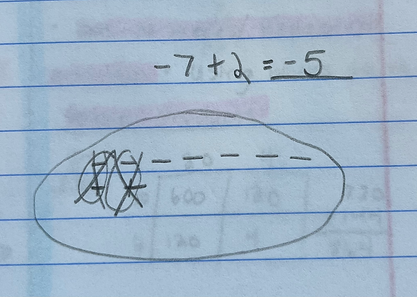
This model relates to the concept of addition because it involves combining chips to obtain the sum. This model provides a visual way for students to understand the addition of negative and positive integers.
Reflection
In this unit, I have learned more about integers and the different techniques I can use to teach. The chip method is an amazing way for students to visualize the math they are completing.
Fractions
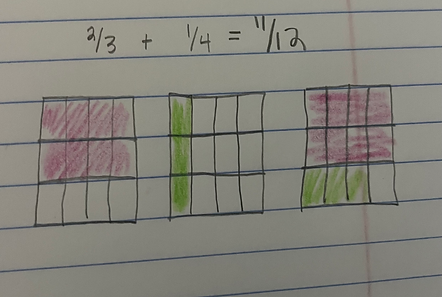
The area model is a wonderful way to help students visualize adding fractions. It breaks down what the fractions look like, allowing students to better understand them. Students can add the pieces together, and eventually, they will no longer need an area model to add fractions.
Reflection
This unit challenged me to recall the fraction learning I have done over my math career. Adding fractions can be tricky for some, so I must learn everything I can to help my future students. The information I relearned in this lesson will carry over to my future classroom.